How American importers, from your local mom-and-pop shops to multinationals, are exploiting a broken enforcement system in an effort to dodge Trump’s tariffs.
Introduction
The messages always arrive by WhatsApp and email, and in this case they sounded a little too good to be legal. Usually, a logistics company (typically based in China) promises to move goods to the United States by sidestepping President Trump’s high tariffs.
For Mr. Kersey, president of the American Lawn Mower Company, these solicitations aren’t an opportunity, but rather a blatant threat to business. His century-old independent firm pays as much as 45% to bring his Chinese-manufactured mowers into the country; while his competitors, he said, do not. "Tariff cheating is much, much worse than tariffs for us."
Kersey, one of the dozen business owners, shipping merchants, trade attorneys and former customs officials who sounded the alarm, is bringing firsthand accounts along with extensive trade data and enforcement records. All of it points to a sprawling, illegal ecosystem of tariff evasion.
This ecosystem does not live entirely in the realm of black and white, much of it falls into a technically-legal gray area. Its overall effect is the hollowing of the tariff regime that the administration has staked an enormous heap of political capital on.
The $112 Billion Gap
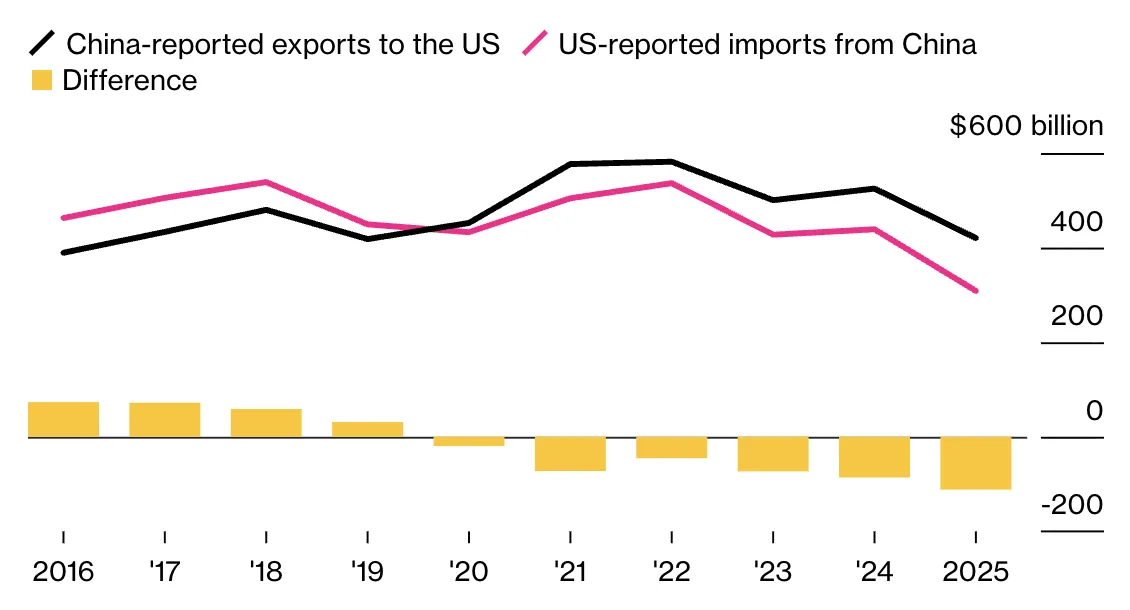
Newly released evidence backs up Mr. Kersey’s anecdotes. Trade data released in February — comparing China’s export records against U.S. Customs arrival logs — recorded a $112 billion discrepancy between what China reported shipping to the United States in 2025 and what officially arrived.
This gap means that as much as a quarter of everything China shipped to America in 2025 could have evaded tariffs. Such a discrepancy dwarfs virtually all historical examples, and cannot be simply explained by routine shipping delays or data lags. Instead, many have suggested something more elaborate is afoot: that a significant share of trade is concealed in routed channels designed to evade detection.
While the declared value of containers arriving from China has plummeted nearly 40%, those of declared containers imported from other countries have remained unchanged. This asymmetry is hard to explain in a fully legitimate market. What it really means is widespread undervaluation: that importers declare goods as worth less than market price to lower their tariff bill.
A Spectrum of Evasion
Since not every step is illegal, the problem is difficult to address. On the legitimate end, the first sale rule (FSR), under U.S. customs law, allows an importer who purchases goods through a multi-tiered supply chain to declare the first price instead of the final one. Since that price excludes the middleman's markup, the resulting tariff bill is typically lower.
Although the FSR has existed since 1988, it has recently surged in popularity. "When the first administration had 25% tariffs on China in 2018, that's when we started getting calls," said one customs attorney to CNBC. "Now with the new tariffs, the first sale rule has started coming up again."
When done properly: with sufficient documentation for every transaction in the chain, an arm’s length relationship between parties, and an audit proving the products were destined for the U.S., the FSR lawfully applies.
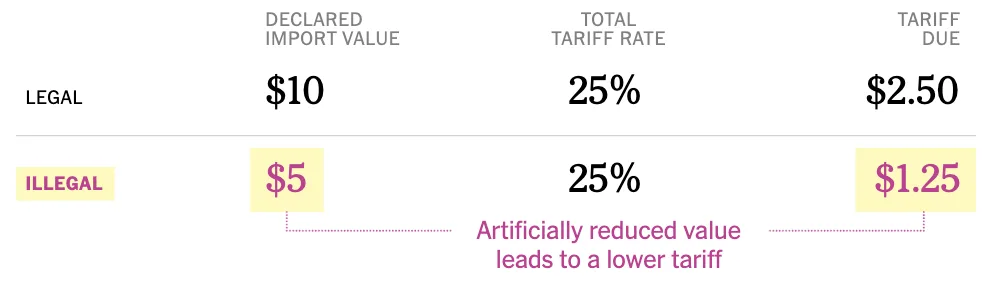
But even then, the FSR sits on the boundary of murkier waters. The same fundamental logic — declaring below-market product values to lower taxes — also underlies many fraudulent import schemes. The difference simply lies in documentation, intent, and whether the declared value has a justifiable connection to reality. But in practice it is exceedingly hard to separate reality from fraudulent distortions.
Despite obstacles for law enforcement, fraudulent importers are not completely unaccountable. Two firms, including Precision Cable, settled False Claims Act (FCA) allegations in 2024 after prosecutors alleged they had falsified invoices — undervaluing their Chinese imports by 70%. More recently, two Colorado companies were indicted for selling Chinese-manufactured forklifts rebranded as "Made in America" by attaching American flags to them, removing Chinese-language markings, and then selling them to U.S. government agencies. Executives faced up to 20 years in prison.
The Freight Forwarder Ecosystem
Tariff evasion has largely been spearheaded by Chinese logistics companies, who actively market their services to American importers. Often, these companies offer Delivered Duty Paid shipping arrangements, where the Chinese firm handles all customs paperwork. This makes underdeclaring the shipment's value far easier. The American buyer then (ostensibly) receives goods whose duties have already been "taken care of."
This moral hazard, for importers, is hard to resist. Because opting out often means insolvency, not merely reduced profits. As one unnamed food manufacturer put it, "My option is to lay off my team or join in the fraud."
Shell companies are frequently layered into these schemes. A Chinese logistics company or supplier often does this by setting up a non-resident entity as the U.S. importer on record. If authorities investigate, they will end up at a fake address and a disconnected phone number.
"If you want to commit fraud, this is how you would do it," said Carrie Owens, a former enforcement official for U.S. Customs and Border Protection (CBP). "You would take on the liability, put it onto a shell company, who then you can run away from very easily and start a new one up."
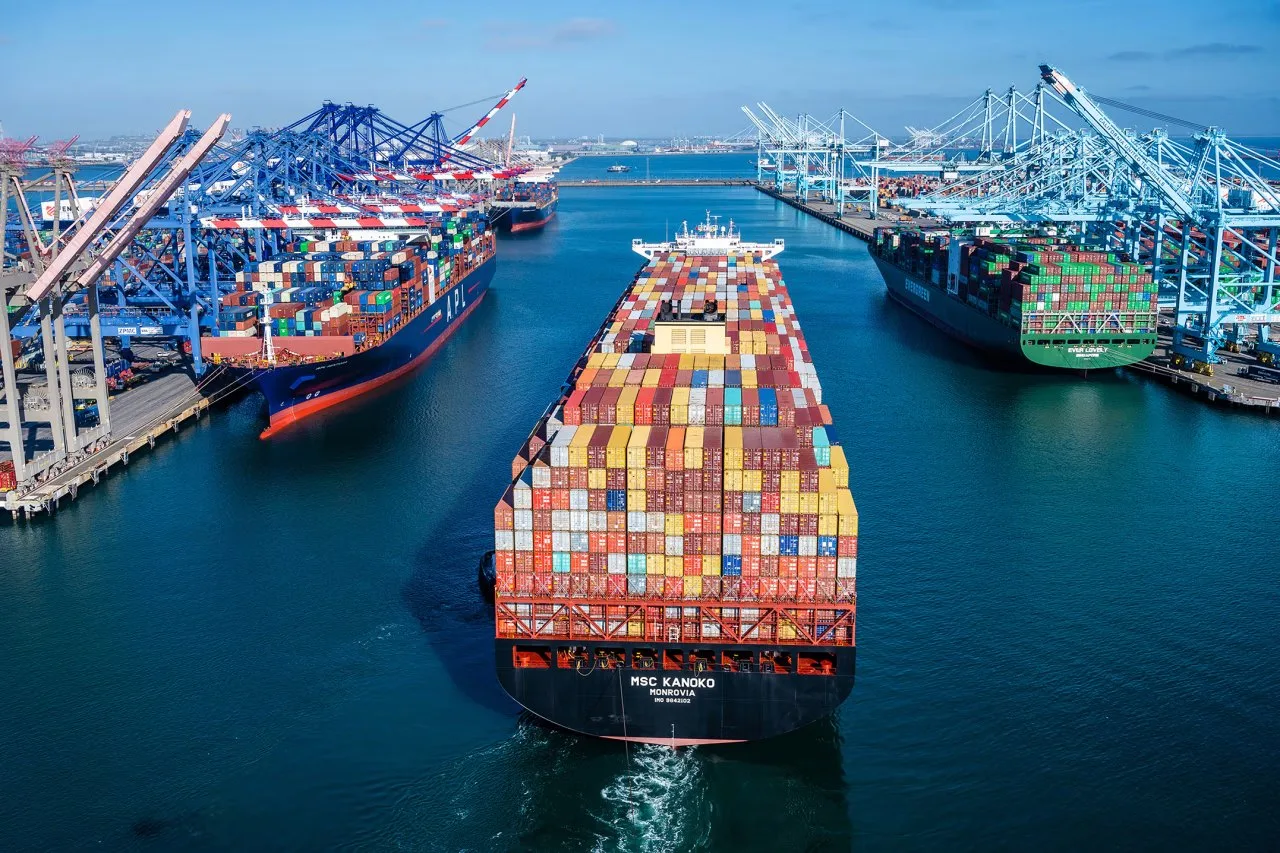
Transshipment provides another layer of protection. By simply routing Chinese goods through Vietnam, Malaysia, Thailand, or Cambodia, shipments are subjected to minimal processing, then re-exported to the U.S. as if they originated elsewhere.
CBP caught one of these schemes when a Vietnam-based manufacturer imported Chinese timber, relabeling it as Vietnamese, and shipping it outward. The goal was to nullify the duties the tariffs were meant to levy.
The Gap in Enforcement is Being Sealed - At Least a Little Bit
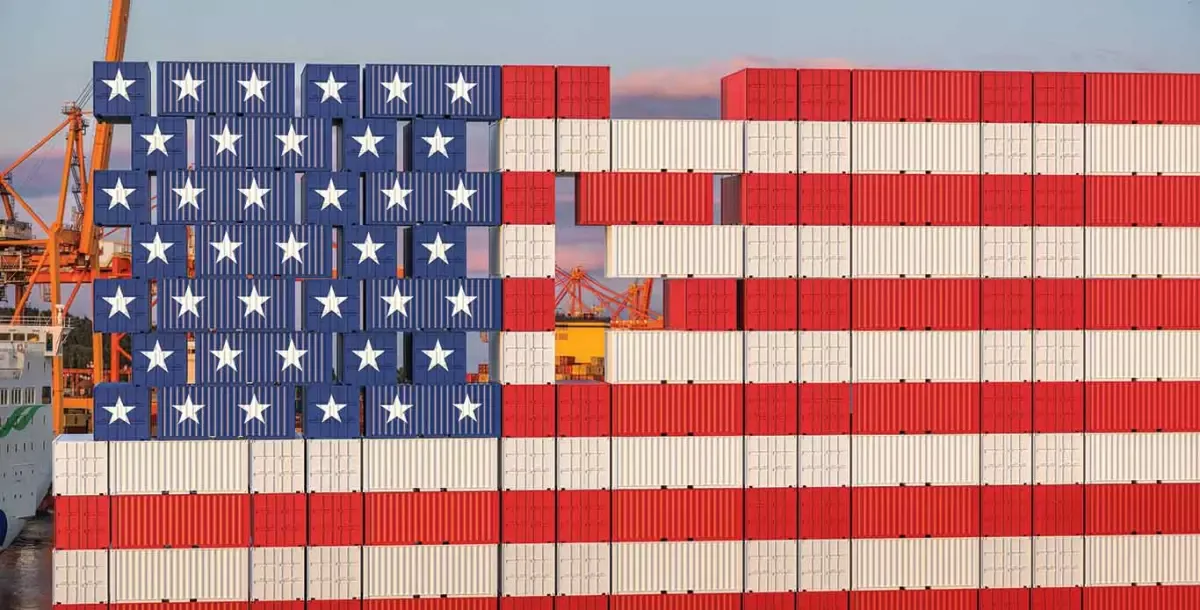
The multi-agency Trade Fraud Task Force (TFTF), launched in August 2025, brought together the DOJ, DHS, and CBP to pursue civil and criminal enforcement. Congress allocated an additional $2 million in January to operate the force, all while the DOJ has been sharpening its swords. Though the administration has mounted a serious response, the results are still dwarfed by the scale of the problem.
Many experts also predict a surge in FCA lawsuits. The civil fraud statute permits treble damages, and rewards customs fraud whistleblowers 15% to 30% of a successful settlement.
This massive incentive has led to a 160 percent increase in duty-dodging complaints between March and May 2025 (compared to the same three-month period in 2024), reaching a filed 1,297 qui tam suits. FY25 saw an all-time record of $6.8 billion in total FCA settlements; roughly double the prior year’s amount.
Cody Matthew Herche, head of the TFTF, reported in February 2026 that the DOJ had recovered $140 million since the agency’s inception, with substantially more in the pipeline. He credited advanced data analytics with enabling investigators to "see through shell games" that previously obscured fraudulent conduct.
These undoubtedly meaningful outcomes are still eclipsed, quite substantially, by the lingering $112 billion gap. That $140 million figure encompasses only ~0.1% of estimated evasion in 2025.
CBP only inspects <1% of containers entering the US. Their gaze is limited, and shell companies that can dissolve overnight only exacerbate this limitation — operating beyond U.S. jurisdiction and subpoena power. The question for any administration going forward is whether AI-driven analytics and expanded whistleblower pipelines are enough to close the gap.
What remains clear is the trajectory of enforcement. The DOJ’s Herche described the current direction as a "fundamental shift" in the government's approach, and trade lawyers across the political spectrum agree that enforcement is intensifying faster than ever. For experts and regulators, the same question nonetheless remains — will we be able to keep up?
Take-Home Points
- A $112 billion gap between Chinese export records and U.S. Customs arrival logs suggests that as much as a quarter of all Chinese goods shipped to America in 2025 may have dodged tariffs entirely.
- Not all tariff avoidance is illegal, and that's part of the problem. Legal mechanisms, including the first sale rule, allow importers to reduce their tariff burden, and the line between legitimate tax minimization and outright fraud is extremely thin.
- A shadow industry has emerged to service tariff evasion, with Chinese logistics companies actively marketing undervaluation services, while shell companies and transshipment routes provide layers of cover that make U.S. enforcement nearly impossible.
- Honest businesses are collateral damage: they bear the full tariff burden while their competitors cheat their way to lower costs, meaning the lack of enforcement actively punishes those who follow the rules.
- Although enforcement is growing, it is nowhere near fast enough. The DOJ's Trade Fraud Task Force has recovered $140 million to date, but that represents just 0.1% of estimated 2025 evasion alone.